Research Program - Improving the moving experience for military members

Introduction
Truss and the U.S. Transportation Command (Transcom) spent 5 years building MilMove - a suite of applications designed to improve the moving experience for military members and their families.
Ahead of the impending launch, the challenge was to reduce risk by conducting research to learn if MilMove gave real users the tools they needed to do their jobs, while alleviating pain points that existed in their current workflow.
Transcom had conducted one research activity in pursuit of this initiative before I joined the project. They were frustrated by the resource draw, confused about what to do with the user feedback they received, and found themselves unsure of the value of continuing to elicit user feedback on the software.
My Role
Design and lead research initiatives to de-risk MilMove's launch
I needed to work collaboratively with the client and Truss' internal project teams to:
Advocate for user research
Understand the unique (and sometimes conflicting) needs that were blocking user research from happening
Build and socialize a research roadmap that addressed those needs while mapping out a path to a successful MilMove launch
Understand the Problem
Use my toolkit
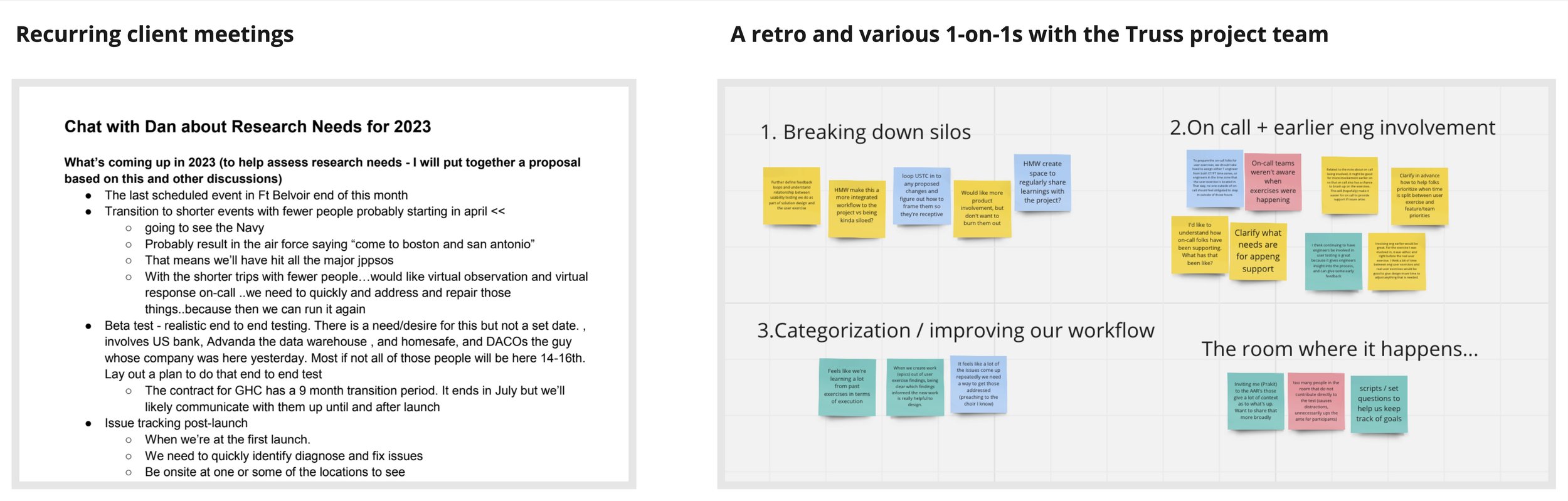
I set up various touch points to understand past obstacles and future needs of Truss and Transcom.
Outline the needs of each group involved
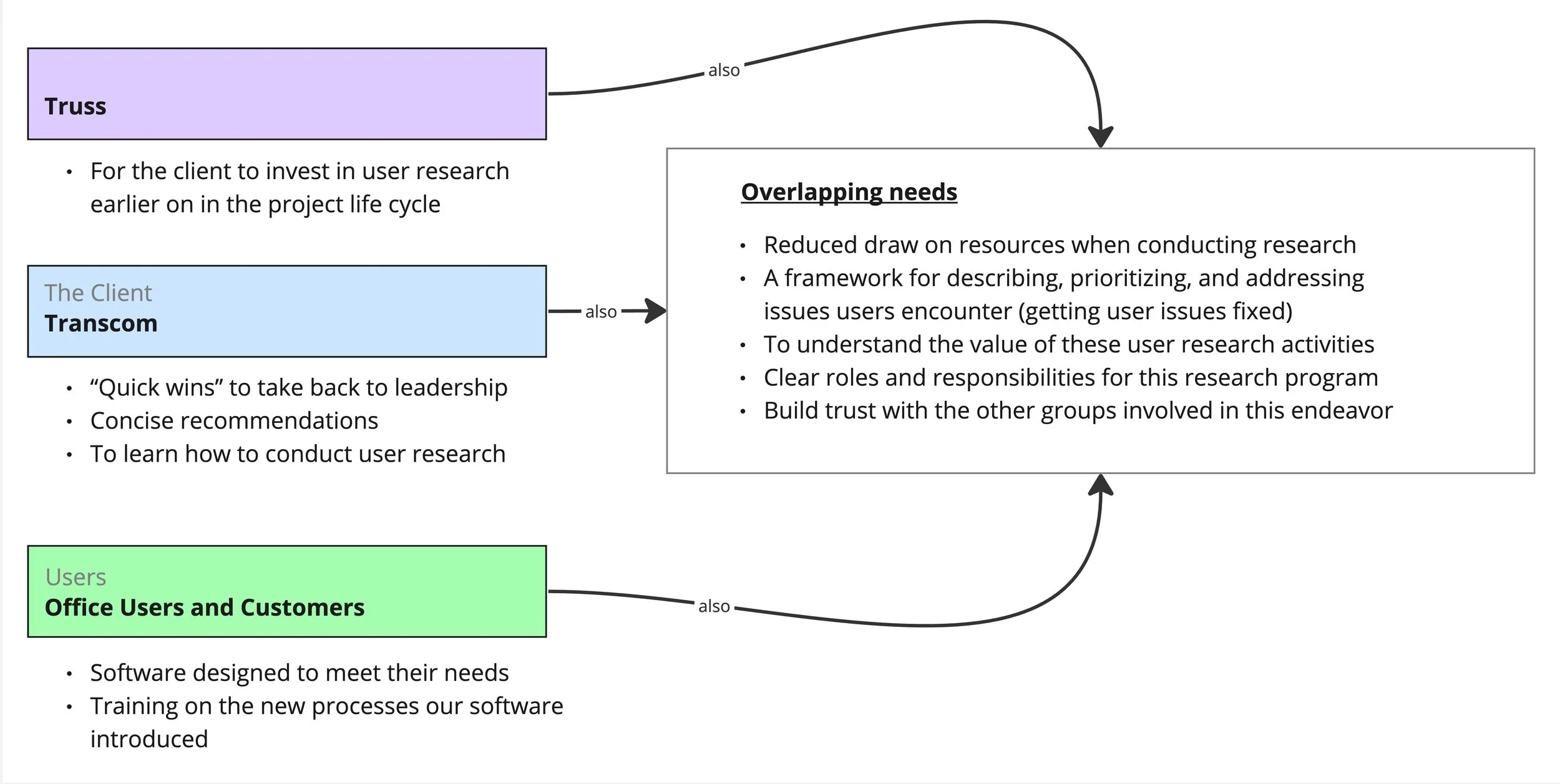
Gathering up all of my notes, I summarized what I’d taken away from the conversations I had.
Create and Socialize Objectives
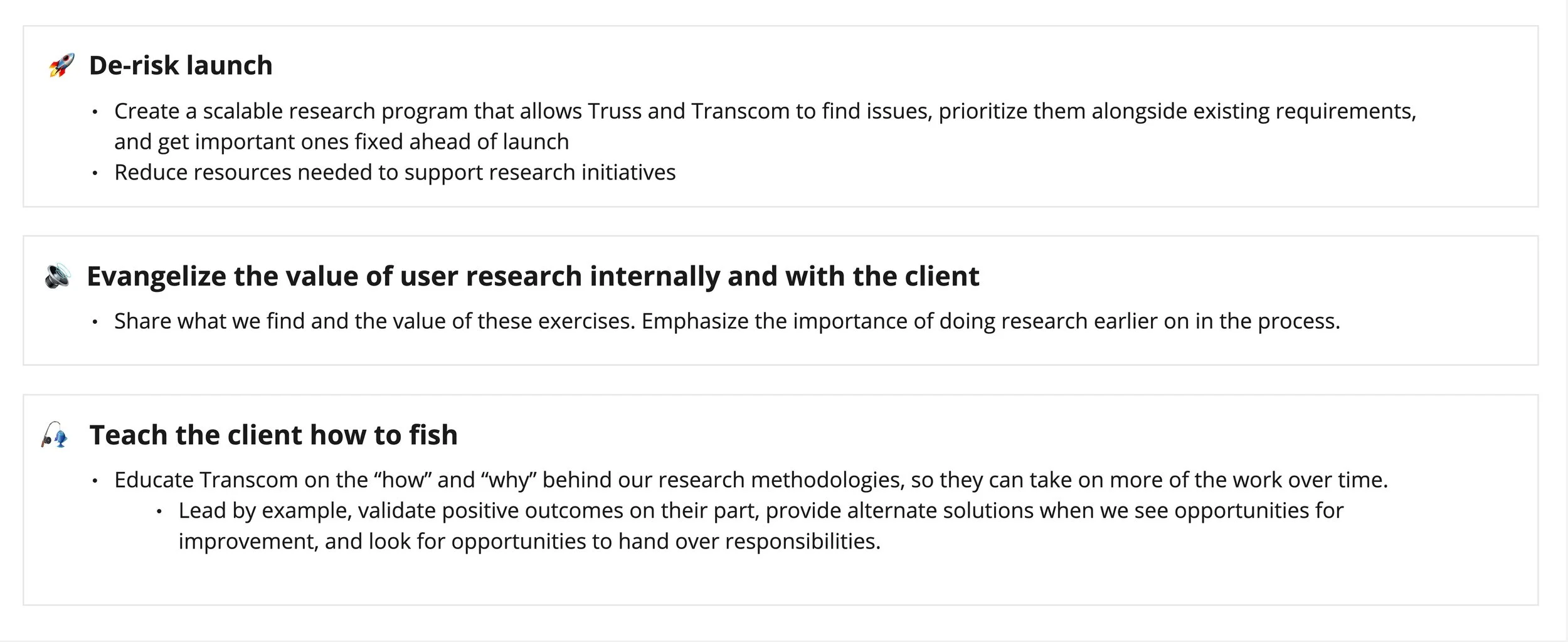
Out of the needs I gathered, I put together a list of research objectives for the project. Shared this with Transcom and Truss using various communication channels (repetition is communication).
Build a Research Plan
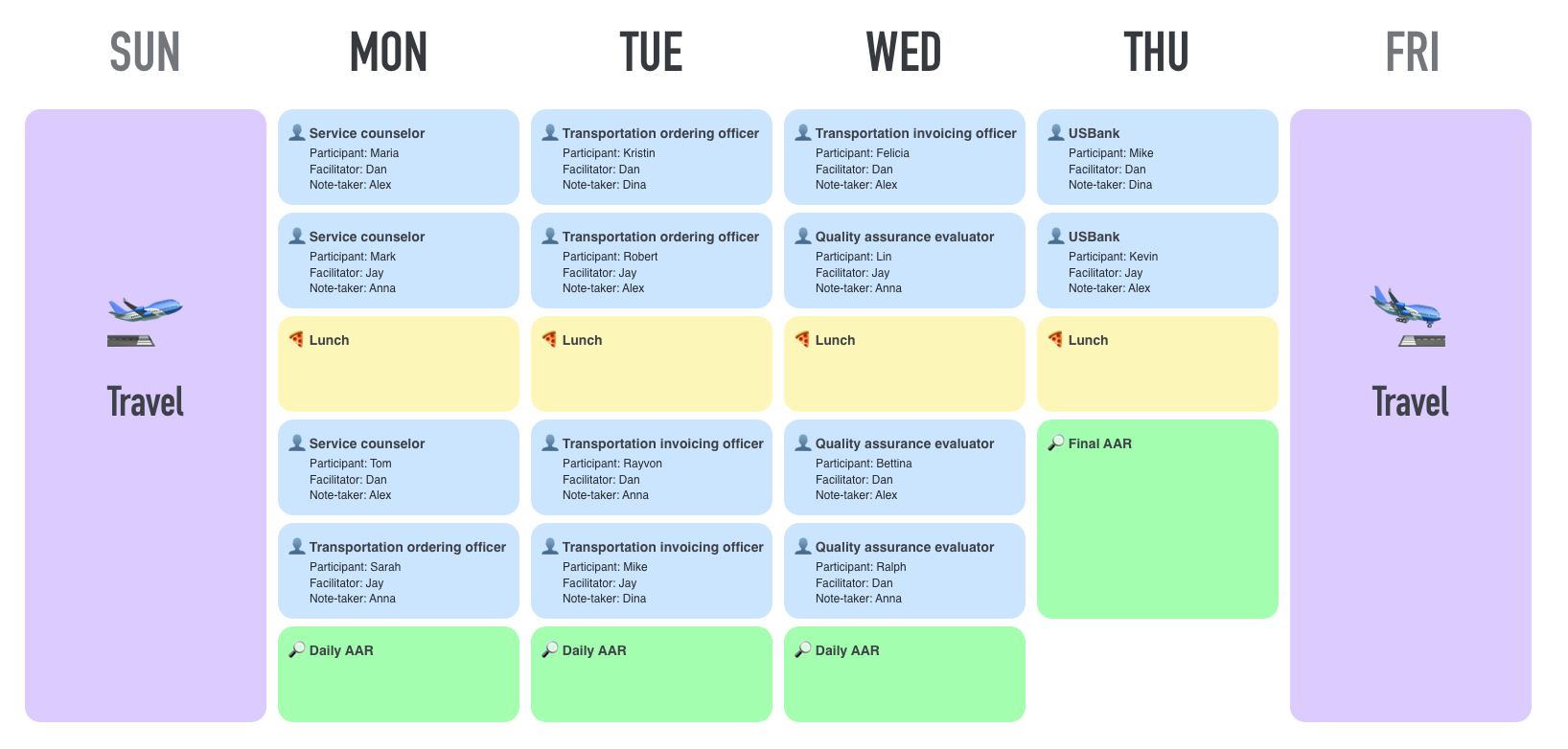
Working alongside Transcom, I built and led a MilMove research program aimed at reducing risk to launch. The project efficiently scaled to military bases in six cities within the United States. At each base, we’d start off by walking office users through a few basic moves. This allowed us to introduce them to the new MilMove software, along with the new roles and business rules that came along with it. From there, we backed off and observed as our users processed moves on their own. Along the way, we documented every issue they encountered, discussed them as a group at the end of the day, and finally prioritized them.
Goals:
Continue traveling to military installations across the United States to identify issues that pose risk to MilMove launch
Develop enough understanding of any issues in order to address them if needed.
Primary Research Questions:
Does MilMove give users what they need to facilitate the moving of military members?
Is the MilMove user experience an improvement on what is in place today?
Methods: Moderated and Unmoderated User Testing, Surveys
Why: MilMove was one part of a large scale program rollout to improve the moving experience for service members. Business processes were significantly changed from what Department of Defense employees were used to, so we started out by walk participants through the new program in a hands-on training-like exercise before letting go of the reigns to allow them to work through moves on their own. At the end of each session, we asked them a series of wrap-up questions about their experience using the new software.
What to Test: Scenarios containing variations of common types of moves
Checkpoints to Ensure Alignment on Process/Issues:
Daily AAR (After action review): Review issues
Final AAR: Prioritize issues and assign action items
Constraints: Each base and military branch operated differently, and they would all need to migrate to the new MilMove/GHC process. This meant we needed to observe users at all major bases to ensure MilMove worked for their unique needs.
Sample: 3-4 participants from each user role, each branch, and every major office in the United States
Timeline: 6 months total. 1 month per base visited.
Locations: Military bases in 6 cities
Truss Resources Needed:
2 design (down from 6 during the previous research activity)
1 appeng
1 product
Execute on the Research Plan (Do the work)
Throughout the process, we tested over 150 scenarios with real users and found upwards of 155 issues (obstacles that impeded users from doing their job with our software). We created and continuously iterated on a framework that allowed Transcom to easily prioritize those issues; handing the important ones back to Truss’s cross-functional teams to fix before launch.
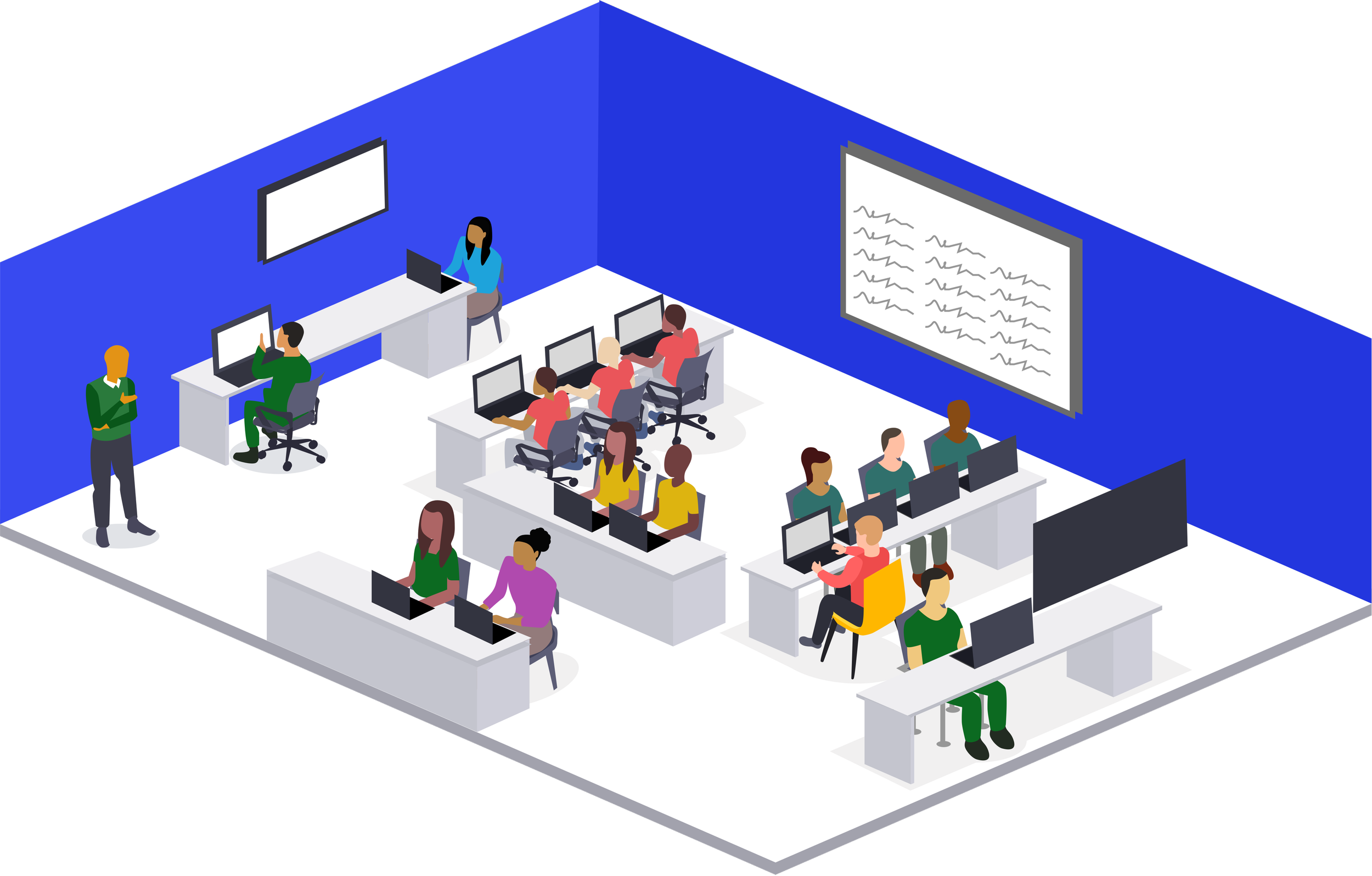
A method to focus on the parts of a move that matter most to service members
Our plan incorporated strategies to hone in on the most critical features to test ahead of launch. MilMove is a large project, and we needed to be economical with our approach. We wanted to make sure MilMove supported the most important parts of a move for service members. So, we started by using data to inform the most statistically relevant features to test. From there, we zeroed in on the riskiest features (the ones with the highest issues, that seemed most confusing for users). Eventually, we handed those scenarios over to each military branch, where they were fine-tuned to ensure our tests accounted for the unique needs of each military branch and installation.
A streamlined approach for capturing, prioritizing, and fixing issues
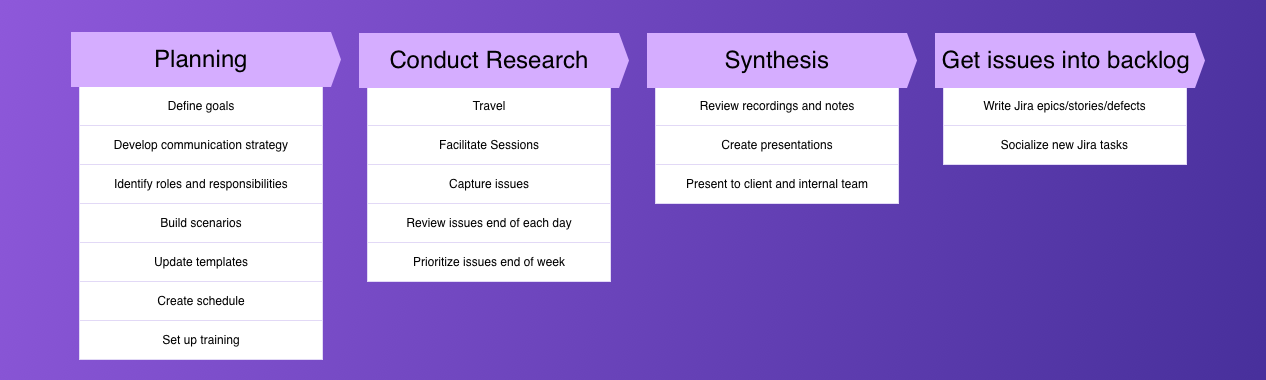
We created a framework that allowed Truss and Transcom to efficiently find and fix important issues, leading to a successful MilMove launch. We did this by designing workflows, templates, and criteria that allowed us to work together to build upon and evaluate each issue as it worked its way from the user into our backlog in a prioritized order. From there, we were able to fix those issues. Along the way, we made sure each stakeholder in this project had the opportunity to provide their input.
Deliverables
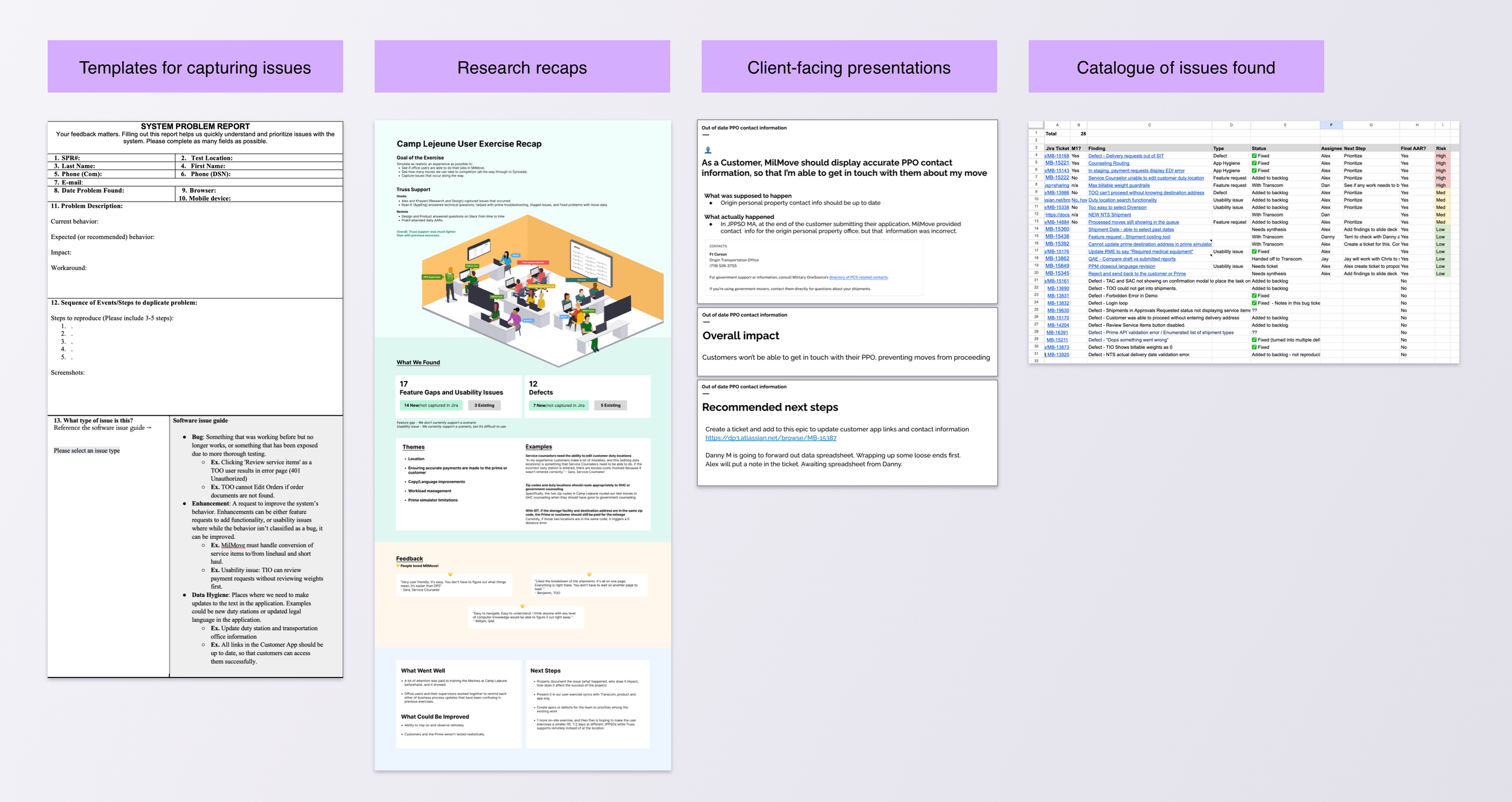
The Results
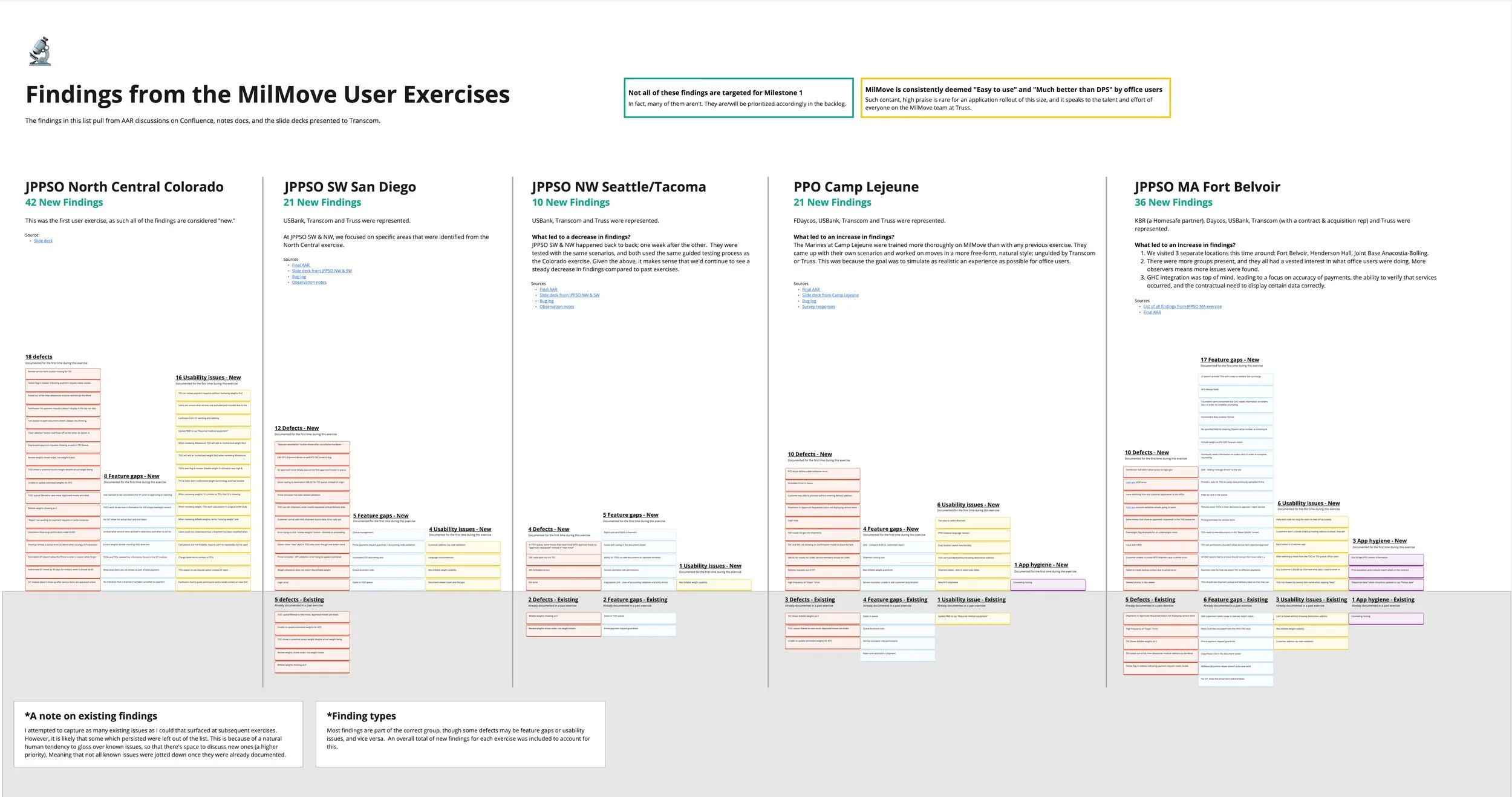
A recap of the program after we had completed 5 user research exercises
🏆 Successfully reduced risk to the launch of MilMove
We found over 150 issues, and were able to fix all of those deemed critical for launch. After testing, soon before launch, we learned that from the perspective of the government, nothing was wrong with MilMove. They could move someone today. Along the way, we received repeat feedback that MilMove was a significant improvement to the current process.
🏆 Strengthened stakeholder relationships
The collaborative nature of this research project helped to strengthen the bonds between important stakeholders, helping with the success of MilMove and the integration of the larger GHC process overall. At each location the military branches, Transcom, Truss, and various other stakeholders were all able to learn about new processes while forming a common understanding of the issues. We were welcomed back by the branches, our client said they were very happy with the support they received, and real MilMove users felt their voices were heard.
🏆 Created a lasting, scalable framework for software validation with real users
Throughout this initiative, I worked with other members of the design team to build and gradually hand off responsibilities for the various components needed to execute this research project . By the end of this initiative, Transcom and members of the Department of Defense had been trained on our research processes and provided with reusable templates. Transcom and the military branches had the tools they needed to de-risk the project on their own. Our client said they learned a lot from the research model, and they were confident they could take things on themselves. Because of the results, USTC higher-ups saw the value of testing with users, and pushed for more of this work. We helped our client partners build their capability to continue this practice long after our engagement.